
Ten years on: Remembering the 2016 thunderstorm asthma event and how far we've come
Nov. 20, 2026
Tomorrow marks ten years since the devastating epidemic thunderstorm asthma event that affected Melbourne and parts of Victoria. We remember the ten people who lost their lives, their families and friends, and everyone whose life was changed by that evening. Their experience is an important reminder that thunderstorm asthma is not simply an unusual meteorological phenomenon. It is a serious public health risk with potentially devastating consequences.
On the evening of 21 November 2016, a severe thunderstorm swept across Melbourne, triggering an unprecedented surge in people experiencing acute breathing difficulties. In the following 30 hours, public hospital emergency departments across greater Melbourne and Geelong recorded nearly 3,500 more respiratory-related presentations than expected. The impact extended well beyond hospitals, with subsequent research estimating around 10,000 additional asthma-related consultations at general practices across metropolitan Melbourne between 21 and 23 November.
Ambulance crews, emergency call takers and hospital staff faced extraordinary demand as thousands of people sought help. The scale of the event was extraordinary, exposing how quickly an environmental hazard could become a major health emergency.
It was a day that changed our understanding of the relationship between grass pollen, thunderstorms and respiratory health, and prompted the development of a world-leading system to help protect the community from similar events in the future.
Understanding the risk
Thunderstorm asthma can occur when high grass pollen levels coincide with particular weather conditions.
In Victoria, perennial ryegrass, which is widespread across the state's pastures, is considered the main grass species associated with epidemic thunderstorm asthma. Intact grass pollen grains are relatively large and are usually trapped in the nose and upper airways, where they can trigger hay fever symptoms. When these grains break apart, however, they release much smaller particles carrying pollen allergens. These particles can become concentrated in the gusty winds ahead of a thunderstorm and, when inhaled, travel deep into the lungs.
In some, the immune system reacts to the rye grass allergens and trigger thunderstorm asthma. The smaller branching tubes that carry air in and out of the lungs become inflamed and narrowed, making breathing increasingly difficult.
Several changes contribute to this narrowing. The muscles surrounding the airways tighten, squeezing the breathing tubes. The lining inside the airways becomes swollen, and extra mucus can build up within them. Together, these changes leave less space for air to move through and has been described as somewhat breathing in and out of a straw. A person who was breathing comfortably can suddenly find that each breath requires much more effort.
Air moving through narrowed airways can produce the whistling sound we call wheezing. The person will feel short of breath, and the increased work of breathing can create a feeling of tightness across their chest or a struggle to catch their breath. There is often also an associated cough. Symptoms can worsen rapidly, and a severe attack can become life-threatening.
People at risk include those with current or past asthma and those with springtime hay fever, including people who have never previously been diagnosed with asthma. Someone who usually associates pollen with sneezing or itchy eyes may therefore be surprised to experience serious breathing difficulties. The risk is greater for people who have both asthma and hay fever, particularly when their asthma is poorly controlled.
When many people develop asthma symptoms over a short period under these conditions, it is known as epidemic thunderstorm asthma. The sudden demand for urgent care can place enormous pressure on ambulance services and hospital emergency departments, as occurred in November 2016.
Not every thunderstorm causes thunderstorm asthma, even when grass pollen levels are high. The combination of airborne allergens, weather conditions and people’s exposure matters. Bringing pollen and weather information together helps identify periods when this combination could put communities at increased risk.
A new approach to protecting the community
The association between thunderstorms, grass pollen and thunderstorm asthma, particularly in Melbourne, had long been documented in the scientific literature. However, none of the previously recorded events had approached the scale of what occurred on 21 November 2016. The challenge in its aftermath was to turn existing knowledge into a service that could help communities and health services prepare, while continuing to investigate the conditions that produce these events.
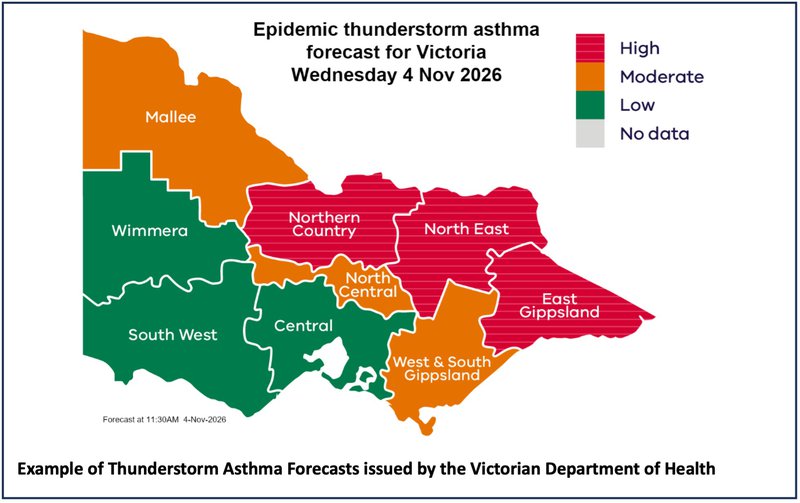
The need for an epidemic thunderstorm asthma risk forecasting system was recognised as a key need, and establishing a service in time for the next grass pollen season became an urgent priority. Developing such a system would require a coordinated effort, bringing together expertise in meteorology, plant biology, public health and emergency management.
Previous research indicated that thunderstorm asthma events occurred most often in November, coinciding with the seasonal peak of airborne grass pollen. Grass pollen was already a recognised allergen and a suspected contributor to these events. If grass pollen was indeed a key factor, developing an epidemic thunderstorm asthma forecasting system would also require a statewide network to monitor and forecast grass pollen levels. These observations would be essential both for assessing the contribution of grass pollen to thunderstorm asthma risk and for evaluating the accuracy of the pollen forecasts themselves.
Following an intensive period of development, the epidemic thunderstorm asthma risk forecasting system became operational on 1 October 2017. The system combines forecasts of grass pollen levels with meteorological predictions of the types of thunderstorms and associated strong winds that can contribute to an epidemic thunderstorm asthma event. The three risk categories, low, moderate and high, are designed to help communities understand the potential risk posed by the combination of grass pollen and storms in their area, while giving local health and emergency services time to prepare for a possible event.
Forecasting is one part of the response. Public health awareness programs have also played an important role in educating Victorians about thunderstorm asthma, the role of grass pollen and the importance of managing hay fever and asthma symptoms during spring.
Together, these measures represent a substantial improvement in Victoria's preparedness for an event of this nature. The epidemic thunderstorm asthma forecasting system is also an excellent example of how collaboration between government agencies and researchers can translate scientific knowledge into practical services that deliver tangible benefits to the community.
A decade of progress in pollen monitoring and forecasting
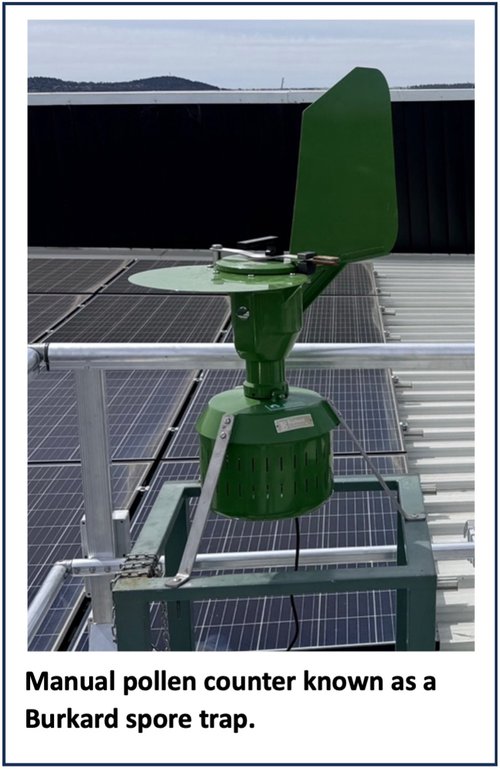
AirHealth provides the grass pollen observations and forecasts that underpin the pollen component of Victoria's epidemic thunderstorm asthma risk forecasting system. The way we monitor and forecast grass pollen levels has changed considerably over the past decade.
Traditionally, pollen monitoring has relied on manual sampling. Air is drawn into a device called a Burkard spore trap, and any pollen grains in that air are deposited or “trapped” on an adhesive-coated glass microscope slide. The slide is removed from the trap and subsequently examined with a microscope by a technician, trained to identify and count the different types of pollen.
During 2017, manual pollen monitoring sites were established across Victoria, extending from Hamilton in the west to Churchill in the east and Dookie in the north. At each site, teams of people were recruited to collect the sampling slides at 9 am each day between 1 October and 31 December. They would then count the pollen grains and submit the daily results before the severe weather forecasts were made.
These counting teams made a vital contribution to establishing the monitoring network. Their efforts provided valuable information about seasonal pollen levels and, importantly, how concentrations varied across different parts of Victoria. However, manual pollen counting is extremely labour-intensive and, although Burkard traps remain a reliable and widely used monitoring method, the need to collect and analyse samples manually limits how frequently results can be produced.
Over recent years, the pollen monitoring network has progressively modernised through the introduction of automated pollen monitoring technology. These instruments continuously sample airborne particles and use sophisticated imaging and classification techniques to identify different pollen types. Whereas manual sampling generally provides a single daily measurement of pollen concentrations, automated instruments can provide observations at much shorter intervals, offering considerably greater temporal resolution.
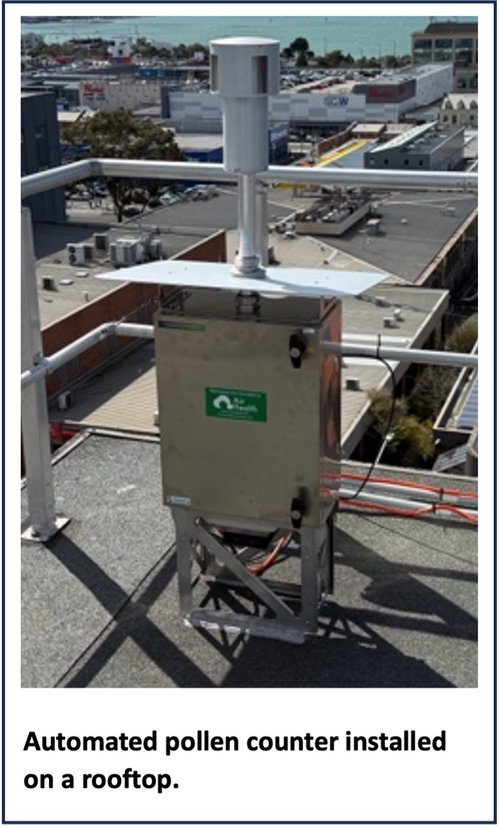
Victoria now has an automated monitoring network operating at seven locations: Melbourne, Geelong, Ballarat, Bendigo, Hamilton, Churchill and Wodonga. The network is supported by university and public health service partners across Victoria, including regional hospitals that host the monitoring equipment. Their contribution, from providing suitable locations and infrastructure to assisting with access and ongoing operations, is essential to maintaining the network. Together, these sites provide a much richer and more detailed picture of how pollen concentrations change throughout the day and differ across the state.
Pollen forecasting has also become increasingly sophisticated. Rather than relying primarily on historical observations and relatively simple statistical relationships between weather conditions and pollen levels, modern forecasting uses machine learning approaches to incorporate a much broader range of information. This includes meteorological forecasts, satellite-derived information about vegetation and grass growth, and observations from the expanding pollen monitoring network.
These developments benefit not only the epidemic thunderstorm asthma risk forecasting system but also the many Victorians who experience seasonal hay fever and asthma. Knowing when and where grass pollen levels are likely to be high helps people make informed decisions about managing their symptoms and planning outdoor activities.
Looking ahead
Although much has changed since November 2016, the possibility of another large-scale epidemic thunderstorm asthma event remains. Victoria continues to experience grass pollen seasons with very high airborne pollen concentrations, and if these conditions coincide with the right type of thunderstorm, thousands of people could once again experience serious breathing difficulties within a very short period. While improvements in forecasting, public awareness and emergency preparedness have strengthened our ability to anticipate and respond to these events, they cannot eliminate the underlying risk. An event of similar magnitude to 2016 remains possible.
The next major advances in pollen monitoring and forecasting will come from improving the detail, accuracy and timeliness of the information available to us. Automated monitoring has already transformed our ability to observe how pollen concentrations change throughout the day. The challenge now is to combine these increasingly detailed observations with advances in meteorological forecasting, satellite-derived vegetation information, atmospheric modelling and machine learning to better understand how airborne pollen concentrations vary across both time and geography.
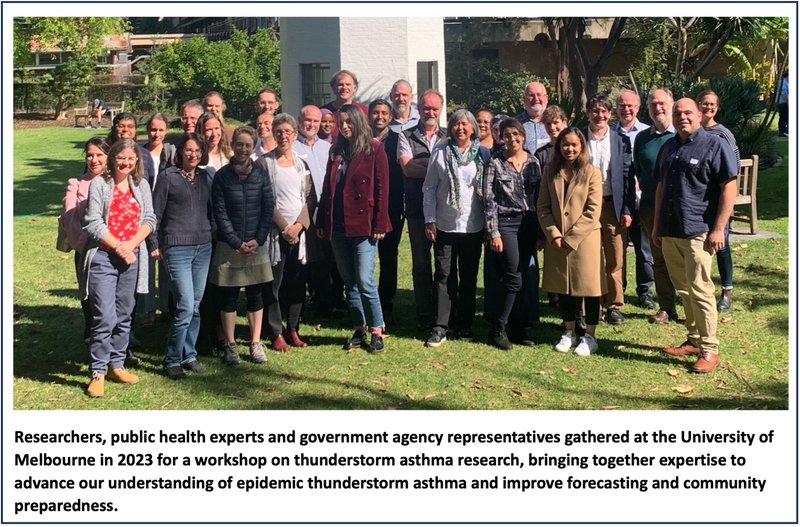
There are opportunities to consider more geographically precise and frequently updated assessments of pollen exposure and thunderstorm asthma risk. Rather than simply knowing that conditions across a large region may be dangerous on a particular day, we want to better understand where and when those conditions are most likely to develop, how quickly they may change, and which communities could be affected. Achieving this will require further research, improvements in our understanding of the processes that trigger thunderstorm asthma, and careful evaluation of forecasting approaches.
These advances have the potential to transform how environmental health risks are communicated and managed. More timely and geographically specific information could help individuals make better decisions about their exposure, while providing healthcare providers and emergency services with more targeted information to support their preparations.
Ten years on, the systems, partnerships and scientific capabilities developed in response to the 2016 event represent a significant achievement. But there is still much more to do. As we remember the ten people who lost their lives and the many others affected, we must ensure that the lessons of that terrible evening continue to shape the work ahead. The challenge for the next decade is to build on what we have learned, continue improving our ability to anticipate dangerous conditions, and ensure that Victoria is as well prepared as possible for the next major event.


© 2010- AirHealth Pty Ltd. All rights reserved.
This information is copyrighted (Terms & conditions). Apart from any use as permitted under the Copyright Act 1968, no part may be reproduced by any process without prior written permission. This includes all pollen information and forecasts.