
Seasonal Outlook for the 2025 Victorian grass pollen season
Sept. 1, 2025
Victoria’s grass pollen season occurs each year when grasses in rainfed pastures across the state flower and release their pollen into the air. The season typically lasts from October to the end of the year. Grass pollen is a major trigger of respiratory allergies such as hay fever and asthma during spring and early summer, and it can also contribute to thunderstorm asthma events, where large numbers of people develop asthma symptoms on days with high pollen levels following certain storm conditions. Seasonal forecasts have been developed to help people with respiratory allergies prepare and plan, as the timing and intensity of the grass pollen season are strongly influenced by a range of climatic conditions including recent rainfall.
Setting the Scene: How 2024 Played Out
Last year’s grass pollen season was relatively moderate overall, but there were still days that caught many by surprise. Between October and December, Melbourne recorded 9 extreme, 11 high, and 23 moderate grass pollen days, leaving 49 days in the low range. While this was less severe than some previous years, the extreme days still caused widespread hay fever symptoms and triggered asthma flare-ups across the community.
This year, conditions look quite different. After a relatively wet July, soil moisture across much of Victoria is in better shape than at the same point in 2024, setting up a stronger base for grass growth this spring.
Soil Moisture Conditions
While autumn 2025 saw below-average rainfall across much of the state, this was partly offset by good falls in July. Root-zone soil moisture is a key indicator of water available to support grass growth and flowering. As shown in Figure 1, soil moisture levels are mostly close to average across Victoria, though parts of central Victoria and areas east of Melbourne remain drier. Overall, soils are much wetter than they were at the same time last year.
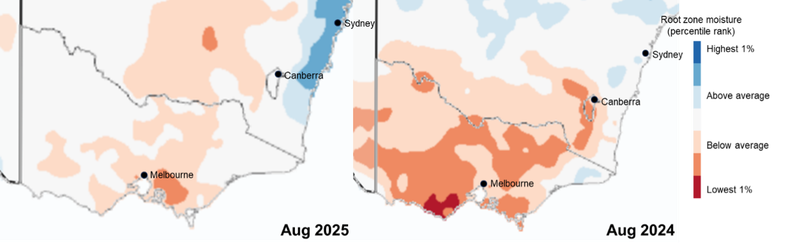
Figure 1: Relative root zone soil moisture levels for south-eastern Australia for August 2025 and August 2024 for comparison. Images are modified from https://awo.bom.gov.au.
Vegetation Greenness and Growth Potential
In Victoria, grasses follow an annual cycle: winter dormancy, vigorous growth and flowering in spring, and then drying out over summer. These seasonal changes can be tracked from space. Figure 2 shows satellite imagery of vegetation greenness in August compared with the same time last year. Pastures dominate western and central-northern Victoria, while around Melbourne they are mainly found to the west, north, and south, with native forests to the east. Overall, the state appears noticeably greener than last year, particularly west of Melbourne, indicating stronger grass growth this year. Closer to Melbourne, however, greenness is similar across both years.
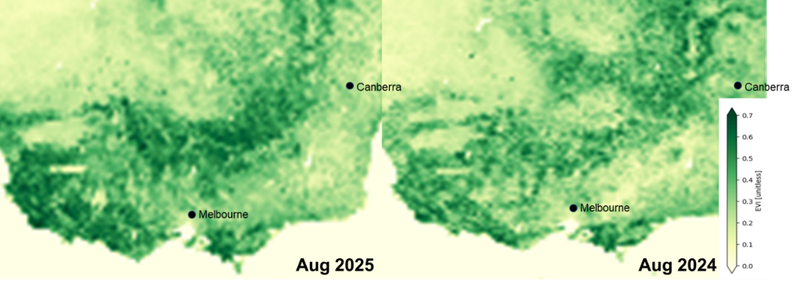
Figure 2: Satellite-based imagery of vegetation greenness for south-eastern Australia for August 2025 and August 2024 for comparison.
Climate Drivers and the Rainfall Outlook
Much of Victoria experienced one of its driest years on record in 2024, and the dry conditions have continued into 2025, with below-average rainfall across most of the state except east Gippsland.
Looking ahead, predictions of a negative Indian Ocean Dipole or -IOD, a major climate driver linked to wetter conditions over southern Australia, particularly the south-east, suggest that Victoria is likely to experience above-average rainfall and warmer daytime temperatures in spring 2025. As Figure 3 shows, the Bureau of Meteorology’s outlook indicates a 65–80% chance of above-median rainfall across eastern and central Victoria between October and December.
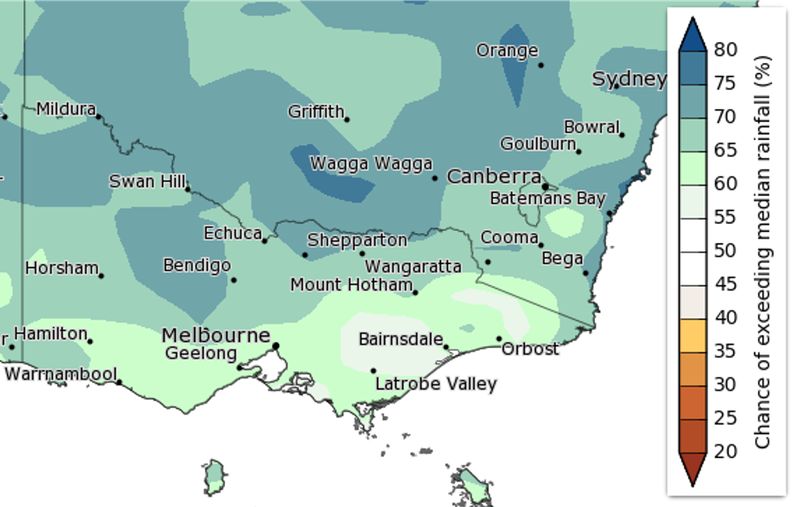
Figure 3: Chance of exceeding the median rainfall for October to December 2025. Image modified from the Bureau of Meteorology.
What This Means for the Season Ahead
This possible shift to wetter conditions will influence the growth and flowering of pasture grasses. Over winter, the drier conditions, lower temperatures, and reduced sunlight have combined to slow grass growth. If September and October are wet, the combination of warmer weather and longer daylight hours will create ideal conditions for vigorous grass growth and a heavier pollen season that will adversely affect people with seasonal hay fever and asthma.
But without the expected rainfall in early spring, the season is likely to be lighter than average, with an earlier onset and potentially an earlier end.
How to Prepare
With the potential for a wetter spring and a heavier pollen season, preparation is essential. People with hay fever or asthma should speak to their doctor or pharmacist before the season begins to review treatment plans. Those with asthma are strongly encouraged to have a written Asthma Action Plan in place so they know exactly what steps to take if symptoms worsen.
The best way to stay informed about how much pollen is in our shared air is to visit the Melbourne Pollen website or download the Melbourne Pollen App on the Apple App and Google Play stores, where you’ll find daily pollen forecasts, push notifications, and tips to help manage your exposure. You can also follow Melbourne Pollen on social media for updates throughout the season.
The Bottom Line
This year’s outlook suggests that the 2025 Victorian grass pollen season could be more active than last year, but how intense it becomes depends on rainfall in September and October. If the rain arrives, we could see stronger grass growth and higher pollen levels heading into peak season. If it doesn’t, the season could be lighter than average.
Either way, keeping up to date with daily forecasts and preparing ahead of time will help you manage your symptoms and reduce the impact on your health.


© 2010- AirHealth Pty Ltd. All rights reserved.
This information is copyrighted (Terms & conditions). Apart from any use as permitted under the Copyright Act 1968, no part may be reproduced by any process without prior written permission. This includes all pollen information and forecasts.