The grass pollen season isn’t over yet
Melbourne has already experienced a heavier-than-average grass pollen season in 2025, and because grasses are still active, high pollen days may continue into early January.
Normally, grass pollen levels drop away around this time as pasture grasses finish flowering, set seed, and begin to dry out (a process called curing). But in 2025, several indicators suggest there’s still “fuel” left in the system, especially around Melbourne and across parts of southern Victoria, and that means additional High grass pollen days are still possible in early January.
What we’re seeing in Melbourne
Melbourne’s cumulative grass pollen total is still increasing and is higher than we would normally expect at this point in the season (Figure 1).
By 31 December 2025, Melbourne’s cumulative grass pollen total reached 4,091 grains/m³, compared with a recent five-year average of ~3,705 grains/m³ for the same date (Figure 1).
This means Melbourne has already experienced a heavier grass pollen season than usual, even before accounting for any additional pollen that may be recorded in January.
We also recorded a High grass pollen day (≥50 grains/m³) as recently as 28 December, indicating the season had not fully shut down before the end of the year.
When a grass pollen season is coming to an end, the cumulative curve usually flattens, showing that little new pollen is being added. In 2025, Melbourne’s cumulative curve has not yet shown a clear end-of-season plateau (Figure 1). This pattern tells us that grasses are still contributing pollen, and that further High pollen days remain possible if conditions are favourable.
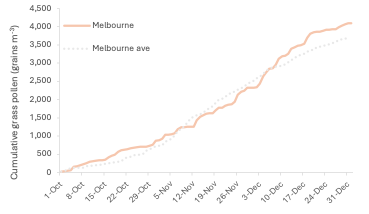
Figure 1: Melbourne cumulative grass pollen concentration (2025 season) compared with the five‑year average.
Why the season is running longer this year
Grass pollen levels depend on whether grasses are still growing and flowering, and that’s strongly influenced by moisture and vegetation “greenness”.
Soil moisture conditions have generally been more favourable than last year
The root‑zone soil moisture comparison suggests that, across large parts of Victoria, soils were less dry than this time last year (Figure 2). Where grasses remain supported by moisture, flowering can persist later into summer.
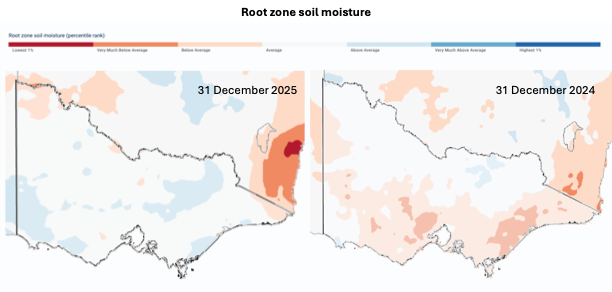
Figure 2: Relative root zone soil moisture levels for south-eastern Australia for December 2025 and December 2024 for comparison. Images are modified from https://awo.bom.gov.au.
Southern areas are greener than the same time last year
Satellite‑derived vegetation greenness (EVI) shows southern Victoria looking greener in late December 2025 than late December 2024 (Figure 3). Greener conditions can support continued grass activity (and pollen production) later in the season.
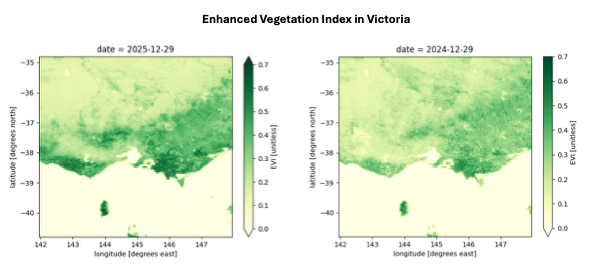
Figure 3: Satellite-based imagery of vegetation greenness for south-eastern Australia for December 2025 and December 2024 for comparison.
Grassland curing supports the same north–south pattern (external source)
The CFA grassland curing maps indicate more advanced curing (drying) across northern and western Victoria, while parts of the south remain less cured/greener. This is consistent with pollen sources easing in some northern areas but continuing longer in greener southern districts.
What this means for you
Even though it’s January, High grass pollen days can still occur, particularly when weather conditions favour pollen release and transport (for example, warmer, windier days).
What you can do
If you’re affected by hay fever or asthma, preparation is key.