
Why You Can Still Feel Terrible on a “Moderate” Pollen Day
Oct. 20, 2025
Even on a “moderate” pollen day, short bursts of extreme pollen can trigger strong allergy symptoms.
You might open the Pollen App, see the forecast marked as Moderate, and think you’re in the clear. But then you step outside, and before long your nose starts running, your eyes itch, and you can’t stop sneezing. It feels unfair—how can a “moderate” day make you feel so bad?
The truth is that pollen levels can jump up and down a lot during the day, and those short bursts can make a big difference to how you feel.
Pollen doesn’t stay still
Let’s look at a recent example from Melbourne, where the graph below shows how grass pollen levels changed hour by hour between 9am on 19th October and 9am 20th October.
Even though the average level for the day was Moderate, there were two periods where pollen briefly reached Extreme levels, once late in the morning, and again around 7 pm.
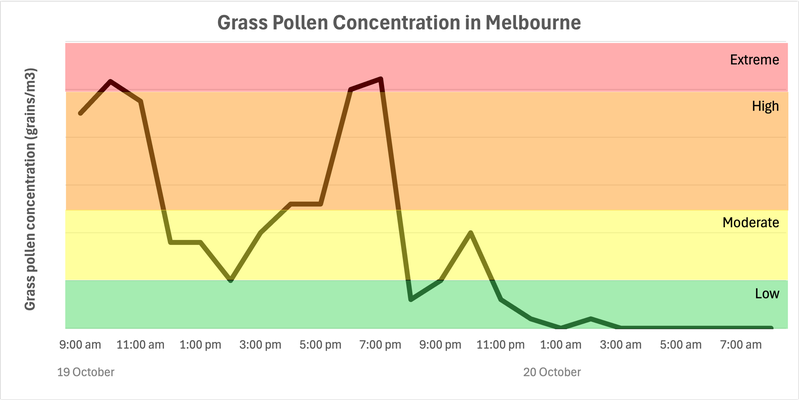
These short-lived peaks can catch you out. You might walk to lunch or the train station during one of those spikes and suddenly find yourself sneezing or wheezing, even though the forecast for the day seemed manageable.
That’s because pollen levels are influenced by weather conditions that change rapidly throughout the day. When conditions line up, pollen can surge in a matter of minutes.
The “average” can hide the extremes
To make things easier to understand, we report daily average pollen levels, a single number that represents a 24 hour period. This gives a useful overview of what the day was like overall. But, as the graph shows, the air doesn’t stay constant. It shifts and swirls, sometimes dropping to calm levels, then spiking dramatically for a short time.
You can think of it a bit like rain. The Bureau of Meteorology (BoM) records rainfall at 9 am each morning, and that number represents how much rain fell over the previous 24 hours. So when you hear that “15 millimetres of rain fell today,” it doesn’t mean it rained steadily all day—it could have all come down in one heavy burst overnight.
There’s even a popular story that the 9 am reading time was chosen because that’s when post-offices opened, and early weather observations were often recorded by postal staff across the country. Whether or not that’s the full truth, it’s a reminder that many of our weather records began as practical, human routines that have carried through to today.
Our pollen monitoring system follows a similar principle: we report a single value that captures the whole day’s pollen exposure, based on measurements taken over many hours. It’s simple, consistent, and comparable, but it can’t always tell the full story of what happens from hour to hour.
When short bursts matter
If you’re outside during one of those short-lived extreme spikes, you might breathe in a large dose of pollen in just a few minutes. For people who are sensitive to grass pollen, that quick burst can trigger strong symptoms that last for hours.
That’s why you can feel terrible on what looks like a “moderate” day. The daily average might smooth out the peaks, but your body doesn’t, it reacts to the moment when pollen hits your airways.
What you can do
You can’t stop pollen from spiking, but you can be ready for it. Here’s how to stay one step ahead:
- Get the app. If you don’t already have the Melbourne Pollen (or your local pollen) app, download it so you can get daily forecasts for your area.
- Turn on notifications. Make sure notifications are enabled so you’ll know in advance when pollen levels are rising and can plan your day accordingly.
- Have a treatment plan. If you get hay fever, talk to your pharmacist or doctor about how best to keep your symptoms under control during pollen season.
- Check your asthma action plan. If you have asthma, make sure your action plan is up to date and that you know what steps to take if your symptoms worsen.
- Stay prepared. Keep your preventer and reliever medications handy, and try to limit time outdoors when pollen levels are at their peak.
The takeaway
A “moderate” pollen day doesn’t always mean a mild one for your symptoms. Just like a day with “15 millimetres of rain” can include one big downpour, a moderate pollen day can still include short, intense bursts of pollen that catch your nose and lungs off guard.
Understanding that helps explain why you might feel worse than the forecast suggests, and why tracking how pollen changes through the day can make a real difference in managing your symptoms.


© 2010- AirHealth Pty Ltd. All rights reserved.
This information is copyrighted (Terms & conditions). Apart from any use as permitted under the Copyright Act 1968, no part may be reproduced by any process without prior written permission. This includes all pollen information and forecasts.